
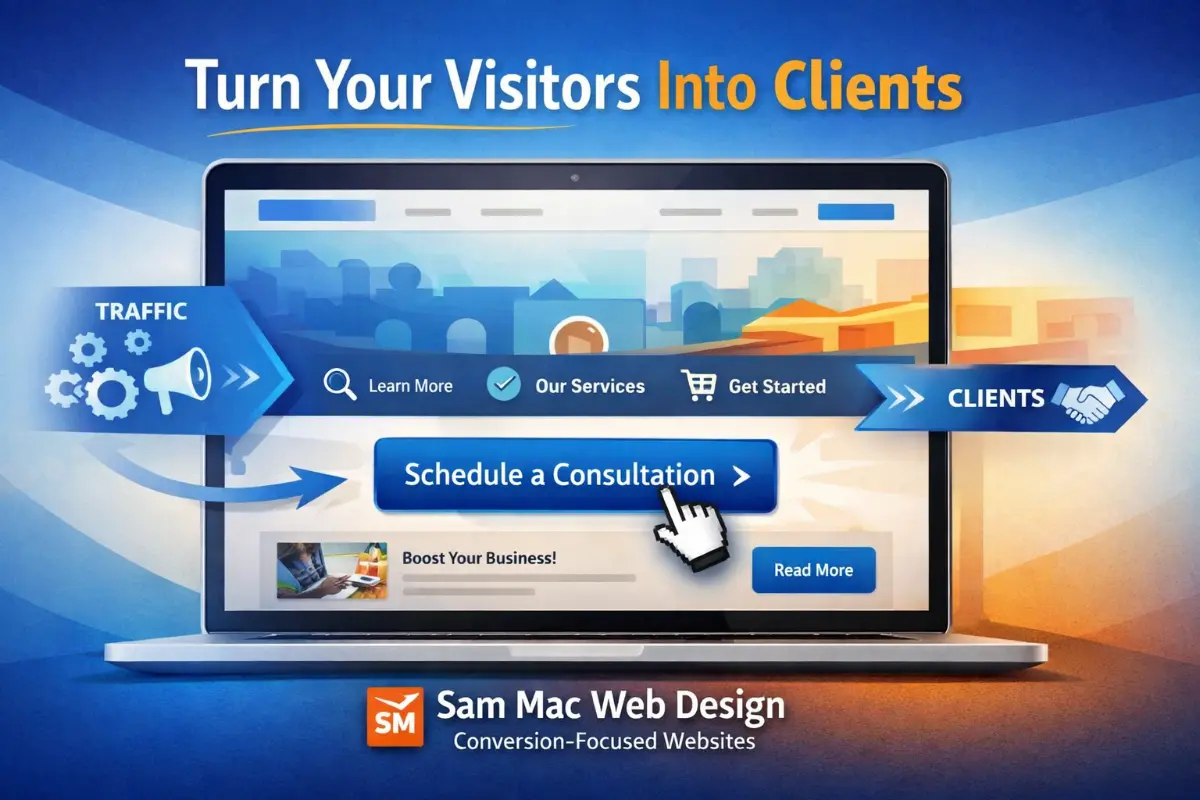
If your website is getting traffic but not generating leads, bookings, or sales, the issue often isn’t design, it’s direction. Visitors don’t convert when they’re unsure what to do next. That’s where strategic Calls-to-Action (CTAs) make all the difference.
A well-designed CTA turns passive browsing into measurable results. Whether your goal is more consultations, quote requests, purchases, or sign-ups, your CTA strategy is one of the most important conversion tools on your website.
Let’s break down how CTAs impact your site goals and how to use them effectively.
What Is a Call-to-Action (CTA)?
A CTA is a clear instruction that tells your visitor what step to take next. It can be a button, link, banner, or form prompt.
Examples:
- Schedule a Consultation
- Get a Free Quote
- Download the Guide
- Book Your Call
- Start Your Project
- Contact Us Today
CTAs are not just buttons, they are decision triggers.
Why CTAs Matter for Website Performance
Many websites focus heavily on layout and visuals but overlook conversion structure. Without intentional CTAs, visitors may:
- Scroll without acting
- Leave without contacting you
- Get distracted by too many choices
- Not understand your services clearly
- Delay action and never return
A strong CTA system helps your website:
- Increase lead generation
- Improve conversion rates
- Guide visitor behavior
- Support business goals
- Reduce bounce rates
- Shorten the decision cycle
Your website should function like a guided path and not an open maze.
CTAs Connect Directly to Site Goals
Every website should have defined goals. Your CTAs should align with those goals.
Examples of Goal-Driven CTAs:
Service Businesses
- Schedule a Consultation
- Request a Proposal
- Book a Strategy Call
Local Businesses
- Get Directions
- Call Now
- Request an Estimate
E-Commerce
- Add to Cart
- Buy Now
- Claim Offer
Content & SEO Sites
- Download Resource
- Join Newsletter
- Get the Checklist
When your CTA matches your business objective, your website starts working for you.
CTA Placement Is Just as Important as CTA Wording
Many sites hide their primary CTA at the bottom of a page. That’s a missed opportunity.
High-performing websites place CTAs:
- Above the fold (visible without scrolling)
- After key benefit sections
- In the middle of longer pages
- At the end of each major section
- On service pages
- In the header navigation
- As sticky buttons (when appropriate)
Visitors should never have to search for how to contact or hire you.
CTA Copy That Converts
Generic buttons like “Submit” or “Click Here” underperform because they lack value.
High-converting CTAs focus on outcome and clarity:
Instead of:
- Submit
Use:
- Schedule My Consultation
- Get My Website Audit
- Start My Project
- Talk With a Designer
Action + Benefit = Better conversion.
Visual Design Impacts CTA Success
Design plays a measurable role in CTA performance.
Effective CTAs:
- Contrast with the page color palette
- Use whitespace to stand out
- Have clear button styling
- Are large enough to tap on mobile
- Use readable fonts
- Avoid clutter around them
A beautiful site that hides its CTA is like a store with no checkout counter.
Mobile CTAs Are Critical
More than half of website traffic is mobile. Your CTA must be:
- Easy to tap
- Visible without excessive scrolling
- Not blocked by popups
- Properly spaced
- Fast to load
Mobile conversion optimization is now a requirement.
One Page = One Primary CTA Goal
Too many CTAs create confusion. Each page should have one primary action supported by secondary options.
Example service page structure:
- Primary CTA: Schedule a Consultation
- Secondary CTA: View Portfolio
- Supporting CTA: Download Service Guide
Clarity beats quantity.
CTA Testing Improves Results
Small changes can produce large gains:
- Button wording
- Color contrast
- Placement
- Size
- Supporting text
- Form length
Conversion optimization is not guesswork. It’s strategic testing and refinement.
How I Build CTA Strategy Into Every Website Project
At Sam Mac Web Design, I don’t just build websites, I build conversion paths. Every site I design or audit includes:
- Goal-aligned CTA mapping
- Conversion-focused page structure
- Strategic placement planning
- Mobile CTA optimization
- SEO-friendly action prompts
- Consultation and lead funnel setup
Because traffic without action doesn’t grow a business.
Ready to Turn Your Website Into a Lead Generator?
If your site isn’t converting visitors into inquiries, bookings, or clients, your CTA strategy may be the missing piece.
Let’s fix that.
I offer website audits, conversion optimization, and full builds designed to support real business goals.
Schedule your consultation and let’s make your website work smarter.
GET IN TOUCH
Leave a Reply